
If you are considering a hair transplant, there is likely one burning question stopping you from booking that consultation: "Is this going to hurt?"
You are not alone. In fact, the number 1 reason why patients put off their procedure is around fear of possible pain. At The Petrus Center for Aesthetic Surgery and Hair Transplantation, we believe that understanding the science of pain management isn’t just for doctors—it’s for patients, too. When you understand how we block pain, you can approach your procedure with confidence rather than anxiety.
Here is the medical reality of why modern hair transplantation is a surprisingly comfortable experience.
1. Understanding the "Pinch" (Fast vs. Slow Pain)
To manage pain, we first have to understand what it is. Medical science categorizes pain into two types:
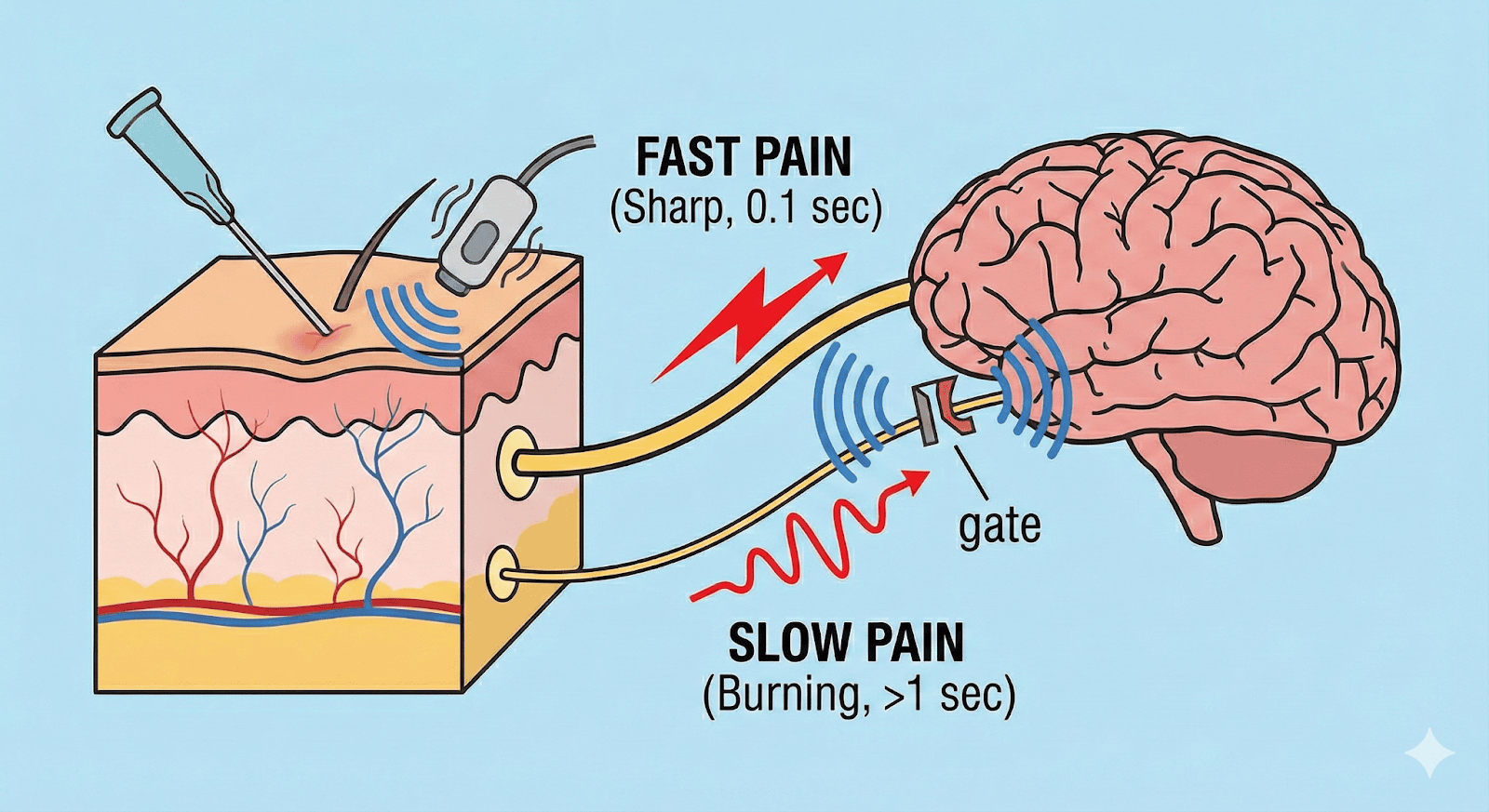
Fast Pain: Felt within 0.1 seconds of a stimulus. This is the sharp "prick" you feel from a needle.
Slow Pain: A burning or aching sensation that begins after 1 second or more.
Our goal during the anesthesia phase is to manage that initial "fast pain" of the needle stick. Once the local anesthetic is delivered, it works by blocking sodium channels in your nerve membranes. This essentially "locks the door" so pain signals cannot travel to your brain. The result? The area becomes completely numb within minutes, and stays that way for the duration of the surgery.
2. "Closing the Gate" on Pain (Vibration Technology)
We employ a technique based on the Gate Control Theory of pain, developed by researchers Melzack and Wall.
The theory is simple: your nervous system can only process so much information at once. Non-painful sensations (like vibration) can "close the gate" to painful sensations (like a needle prick), preventing them from reaching the central nervous system.
How we use it: When administering anesthesia, we often apply a vibrating device to the skin near the injection site.
Because your nerves are busy processing the vibration, the sensation of the needle is significantly reduced or even unnoticed.
3. Numbing You Before We Numb You (Topical Anesthesia)
We can also employ a layered defense to reduce discomfort. Before a needle ever touches your scalp, we can utilize topical anesthesia.
We use "eutectic mixtures" (specialized medical creams containing lidocaine and prilocaine or tetracaine). These are applied to the donor and recipient areas at least one hour before the procedure begins. These creams migrate into the dermal layers of your skin, effectively numbing the nerve endings and blunting the initial prick of the injection. This is particularly helpful for patients who feel anxious about needles.
4. The Chemistry of Comfort (Buffers & Temperature)
Did you know that the temperature and pH of the anesthesia can affect how it feels?
Temperature: Cold fluids can shock the tissues. We aim to keep our anesthetic solutions at room temperature or warm them slightly, which studies show can reduce the pain of injection.
pH Balancing: We may buffer our solutions to match your body’s natural pH levels, preventing the "sting" often associated with medical injections.
Slow Injection: Pain is often caused by injecting fluid too quickly, which increases tissue pressure. Our technique involves injecting very slowly to keep tissue pressure low and comfort high.
5. The "Talk Anesthesia" Technique
Believe it or not, your mindset and environment play a massive role in how you perceive pain. We practice "Talk Anesthesia"—maintaining a constant, reassuring dialogue with you to alleviate concerns.
Combined with a pleasant office ambience and music, this psychological distraction minimizes apprehension. Interestingly, clinical observations suggest that patients who are highly motivated to restore their hair actually have higher pain thresholds and experience less pain during the process.
The Bottom Line
It would be a mistake to call any surgery 100% sensation-free , but the pain felt during a modern hair transplant is acceptable to almost all patients. By combining vibration technology, topical numbing creams, slow injection techniques, and long-acting anesthetics, we ensure your experience is safe, relaxed, and focused on the excitement of your new look—not on the procedure itself.